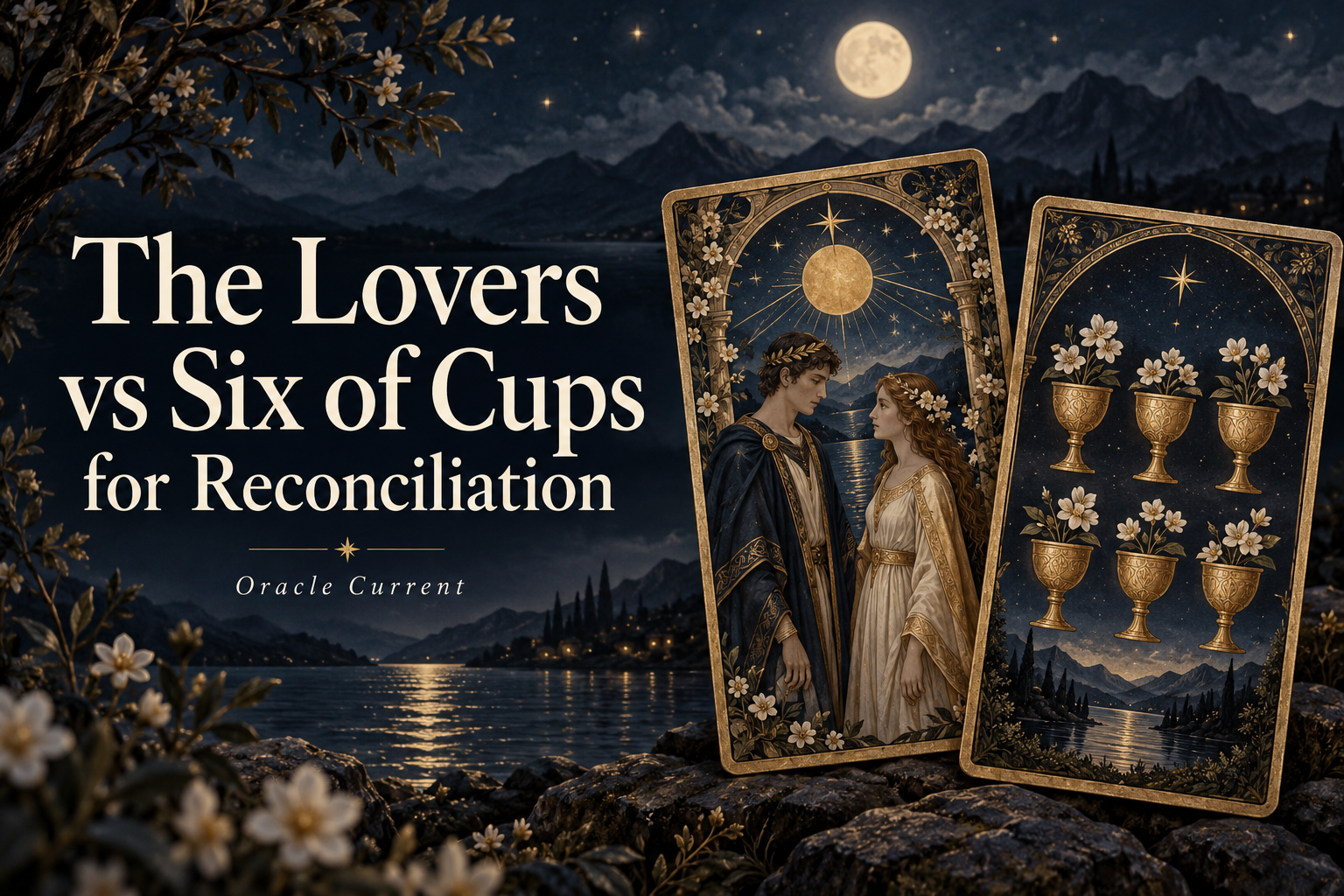
The Lovers and Six of Cups can both feel hopeful in a reconciliation reading, though they bring different questions into focus. The Lovers invites us to consider choice, values, and whether a relationship fits the life we want now. The Six of Cups draws attention to memory, nostalgia, and the emotional familiarity of a past connection.
When both appear, we can explore how a remembered relationship influences a present decision. At Oracle Current, we use tarot as symbolic reflection: these cards cannot verify an ex’s feelings, predict their next message, or guarantee reunion. The useful work comes from connecting the reading to a decision you can actually make.
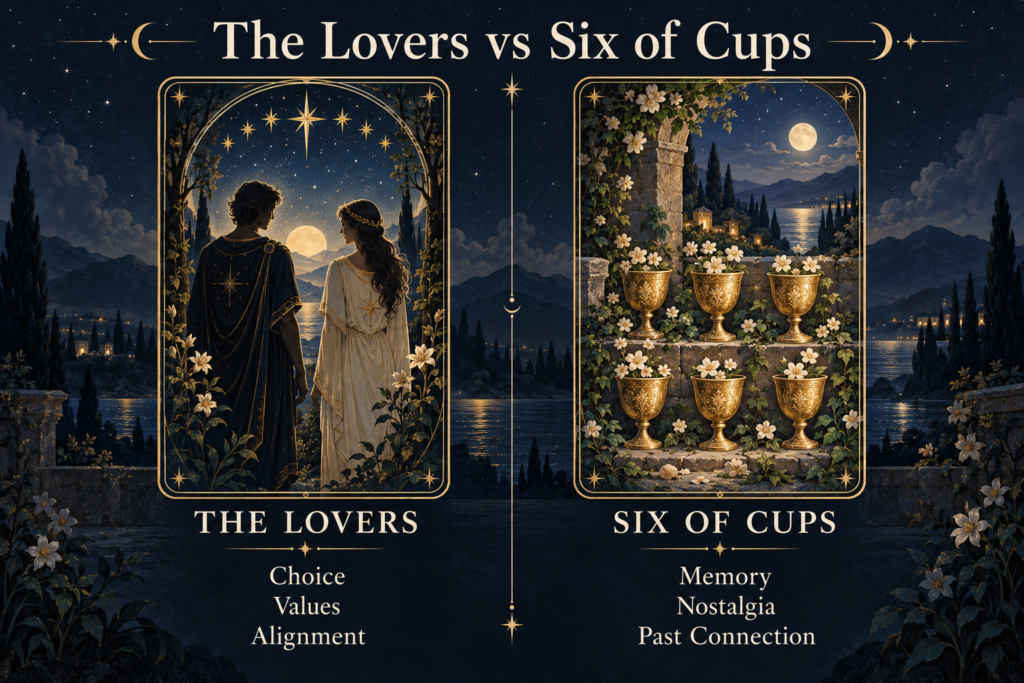
The Lovers vs Six of Cups: A Reconciliation Comparison
In love and reconciliation readings, the Six of Cups is often associated with someone from the past, familiar affection, or the possibility of reconnecting with an old relationship. The Lovers is commonly interpreted through romantic connection, partnership, and the choices involved in committing to someone. These associations help explain why both cards attract attention after a breakup, although neither establishes another person’s intentions or guarantees a reunion.
For this comparison, we draw on the contemporary interpretations in Tina Gong’s Labyrinthos guides to The Lovers and the Six of Cups. These describe symbolic associations within tarot practice, including choice and harmony for The Lovers, and familiarity and nostalgia for the Six of Cups. Our reconciliation questions apply those themes to specific situations and should be understood as reflective suggestions.
| Point of comparison | The Lovers | Six of Cups |
|---|---|---|
| Main emphasis | Choice, values, alignment | Memory, nostalgia, past connection |
| Common love reading | Romantic connection and partnership decisions | A past relationship, familiar affection, or possible reunion |
| Upright emphasis | Considering connection and compatibility | Revisiting affection and familiarity |
| Reversed emphasis | Examining conflict, indecision, or misalignment | Examining attachment to the past or movement beyond it |
| Useful reconciliation question | What would I be agreeing to if we tried again? | Which part of our history am I hoping to recover? |
| A detail to examine outside the reading | Whether present expectations fit | Whether remembered patterns still describe the relationship |
Neither card needs to win a contest over which is the “stronger” reconciliation sign. If your question concerns why you keep looking back, the Six of Cups offers a relevant starting point. If you are considering an invitation to reconnect, The Lovers gives you a way to examine what accepting would mean.
When The Lovers Is the More Useful Starting Point
Imagine an ex has suggested meeting, and you already know you miss them. The unresolved issue is whether you want the kind of relationship they are offering now. In that hypothetical situation, working with The Lovers might mean considering exclusivity, communication, or plans for where to live before deciding what you would welcome.
You could discover that a conversation interests you while a renewed commitment feels premature. You could also discover that your priorities have changed since the breakup. Both possibilities belong in a reading about choice.
For a fuller look at the card on its own, our guide to The Lovers tarot card in love explores its upright and reversed meanings across relationship situations.
When the Six of Cups Is the More Useful Starting Point
Suppose an old photograph makes you want to reconnect after weeks of feeling settled. Before making a decision, you might use the Six of Cups to name what that image brings back: affection, shared routines, a particular place, or an earlier version of your life. That detail can help you understand why the urge arrived today.
Try writing down what you miss with enough specificity that it could be discussed. “I miss our Sunday walks” gives you something clearer to examine than “Everything was better then.” You can then consider how that memory fits alongside the everyday experience of the relationship.
Our guide to Six of Cups reconciliation meaning looks more closely at nostalgia, emotional familiarity, and revisiting a past connection.
What If The Lovers and Six of Cups Appear Together?
We would begin with the question and the spread positions. If the Six of Cups falls in a position labeled “what influences my decision,” memory becomes the subject to examine; if The Lovers falls in “what needs attention,” the reading can turn toward your criteria for choosing. Drawing the cards in the opposite order does not automatically reverse the message, especially if you never assigned positions.
A possible interpretation is that something you valued in the relationship still matters to you, and you are considering whether it has a place in your present life. You might explore rebuilding with that person, or recognize a quality you want in a future relationship. The surrounding circumstances help you decide which application is relevant.
If The Moon joins the reading, consider which part of the situation remains unclear. Our guide to The Moon tarot after a breakup explores that uncertainty through upright and reversed meanings and a short decision flow.
How Upright and Reversed Pairings Change the Questions
The four combinations below are our suggested reflective readings, informed by the general upright and reversed associations described in the Labyrinthos guides above. The question, deck, and reader’s approach can all affect the interpretation. A reversal can highlight something that deserves attention without making the entire reading negative.
| Pairing | A possible reflective reading | A question to take beyond the cards |
|---|---|---|
| Both upright | Affectionate memories may be part of a choice you want to consider openly. | What would a new agreement between us actually include? |
| The Lovers reversed + Six of Cups upright | The warmth of the past may sit alongside a present disagreement or unresolved decision. | Which issue would still divide us even after a happy reunion? |
| The Lovers upright + Six of Cups reversed | Clarifying your values may involve changing how you relate to the old relationship. | Could I choose differently now, including declining a familiar arrangement? |
| Both reversed | It may help to slow down and examine both the old story and the decision attached to it. | What remains unclear, and can I leave the decision open while I address it? |
The reversed Six of Cups deserves some flexibility: readers may explore feeling caught in the past or becoming ready to move beyond it. Notice which interpretation your circumstances support instead of choosing whichever makes reconciliation sound most likely. If you do not use reversals, you can still ask about the difficult or unresolved side of each card.
Memory → Choice → Action: A Framework for the Reading
Memory → Choice → Action is our editorial exercise for turning this comparison into something usable after you put the deck away. It is not a traditional spread with a promised outcome. You can work through it with the two cards in front of you or simply use three headings in a notebook.
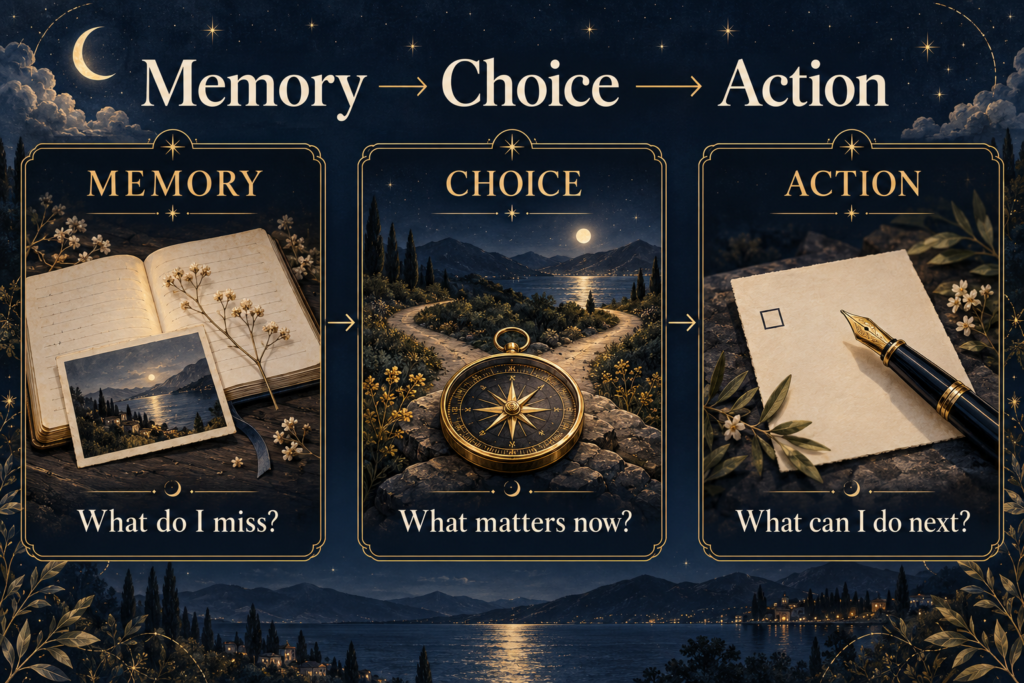
1. Memory: Describe What You Want to Revisit
Write down one moment or quality you miss, then add a relevant difficulty from the same relationship. Try to stay with specific events rather than broad judgments such as “We were perfect” or “It was all a mistake.” Giving both experiences space makes the next decision easier to describe.
The aim is to identify which memories still influence your view of the relationship. Those details can help you recognize what you valued and what deserves a closer look before considering reconciliation.
2. Choice: Turn a Value Into a Condition
Choose one value that matters to the decision, such as reliability, honesty, or independence. Then describe what honoring it would look like in ordinary life. A condition you can discuss is more useful here than a general wish that the relationship will feel different.
Reliability, for example, might mean making plans both people can realistically keep and giving notice when something changes. You can also name what you are prepared to offer yourself. This step should leave room for either person to decide that the proposed relationship does not fit.
3. Action: Choose a Step That Fits the Information Available
Your next step depends on what is actually happening between you. If contact is welcome and both people have expressed interest, you might ask one specific question about the issue that ended the relationship. If you have no new information, your action might be to write down what you would need to know and continue with your existing plans.
A request for no contact, a block, or a clear refusal sets a boundary to respect. In that situation, keep the exercise private rather than looking for another channel to reach the person. Where there has been intimidation or harm, consider your safety and support before any idea of reconnection.
A Worked Example
Imagine an ex sends a friendly message about a holiday you once took together. You draw both cards upright and feel tempted to treat the exchange as the beginning of a reunion. Applying the framework, you first identify the memory the message stirred: feeling relaxed and close during that trip.
Next, you recall that the breakup involved repeated disagreement about commitment. Your choice is whether you want to explore contact when that issue remains unresolved. If you want to reply and contact is welcome, a possible question is: “I’ve enjoyed catching up. Are you hoping to discuss our relationship, or are you keeping this friendly?”
Their answer may clarify the purpose of the conversation, though one answer does not settle every concern. You can decide whether to continue talking after hearing it. The exercise has helped you identify missing information before making a larger decision about getting back together.
Using the Framework as a Three-Card Spread
If you prefer a three-card spread, assign Memory, Choice, and Action to the three positions before drawing. Each card then offers imagery or symbolism to explore through the corresponding step above, regardless of whether The Lovers or Six of Cups appears.
After interpreting the cards, write one sentence beginning “What I know outside the reading is…” This connects the exercise to your current circumstances and gives you a practical point of reference afterward.
What Would Make Reconciliation Worth Discussing?
The two cards raise different questions about a potential reunion, but an actual conversation can help clarify whether both people want the same kind of relationship. Affectionate memories may open that conversation, while a clear discussion of commitment, expectations, and the reasons for the breakup reveals what rebuilding would involve.
If your ex expresses interest in trying again, consider what they are proposing and whether the changes you would need are realistic. Their actions over time will give you more to evaluate than a single emotional exchange. You might also discover that your expectations still differ, which is useful information for deciding what to do next.
Before You Put the Cards Away
Finish by writing down the decision that is actually in front of you: whether to reply, what to ask, whether to keep a boundary, or whether to leave things as they are. Add the information you would need before taking a larger step.
The Six of Cups may help you understand the pull of a familiar relationship, while The Lovers invites you to consider what you would choose in the present. You can appreciate what the cards symbolize and give yourself time to evaluate what is happening in real life.